Saturday, May 09, 2009


Maryland Sheep & Wool, 2009
a bit more here.

Friday, May 08, 2009


Camping equipment advertising cards ca. 1920's

Wednesday, April 29, 2009


Abercrombie's Camp 1928 catalog.

David T. Abercrombie organized Abercrombie's Camp in 1908, after leaving Abercrombie and Fitch. Catalog found in the late '90's when Barnett Canvas Goods were moving out. More posts to follow.
"By breakfast time we had made good progress and were able to look out on the neighbouring hills"


"After breakfast we began to tackle or job in real earnest."


Climbing Borrowdale Fells, Cumbria (1926)
An extract from Claude Friese-Greene's 'The Open Road'

view it here. more extracts here.

For those of you interested in climbing and the history of gear, I would recommend Invisible on Everest: Innovation and the Gear Makers. Written by Mary B. Rose in conjunction with Mike Parsons, who ran the British company Karrimor for a number of years, Invisible on Everest is a highly readable romp through the history of climbing / outdoor gear. From the early days of Edward Whymper, Blacks in the 1930's, to Yvon Chouinard, the authors trace the growth of climbing and the various innovations in gear that resulted as a collaboration between climbers and producers. Much of the focus is on British and European companies so don't expect a detailed history of Gerry, North Face, or Holubar. Dispelling the notion that climbers on early expeditions on Everest were dressed for 'a Connemara picnic, surprised by a snowstorm', the book reveals that much of the gear in the past was sophisticated, well thought out, and, ultimately, effective.

Tuesday, April 28, 2009


A few choice labels. Most have been with me for years. The Brooksgate jacket was purchased ca. 1985 as part of a suit. The pants have long since been discarded, but the jacket still fits and is in good condition. The North Face jacket was purchased in 1980 in Jackson Hole, Wyoming. It too is in good condition. Others are hand me downs or thrift store finds. I wonder how many things I buy today will last as long?

Tuesday, April 07, 2009

Sewing the front pocket


Pocket completed


Handsewn button holes. Need to work on this.


Hand warmers.


This is what I've been up to for the last few days. More or less finished. I need to get some toggles and cord and I'll be done. The hardest part was the neckline and parts of the hood. I had to do the neck three times before I was satisified. I have enough fabric left over for a second version and I'd like to encorporate some modifications: zippers on the sides, a zippered front for the hood, some velcro on the cuffs, and possibly a different front pocket. I have a copy of "Sew & Repair Your Outdoor Gear" by Louise Lindgren Sumner waiting for me at the library and I hope it has some good tips. Brother Tom has put an order in, but he'll have to wait until I get this thing down. Will report shortly on how well it keeps out the elements.

p.s. Check out Archival Clothing for some detail shots on the Hilltrek jacket I purchased a few months back. Nice jacket - made in Aboyne, Scotland down the road from my namesake, Alford.

Saturday, April 04, 2009


Seriously coveting this, but at $240, a serious investment. Nice looking, though. Maybe I can knit something in a similar vein.

This Sunday is the Ronde van Vlaaderen ( Tour of Flanders) and next Sunday, Paris-Roubaix. Two of the great Spring Classics. You can watch some of 1976's "A Sunday in Hell", a 1977 documentary directed by Jørgen Leth, here and here. Anyone have a copy?

Thursday, April 02, 2009

Courtesy the Mark H. Dunkelman Collection


“Whose Father Was He?” — an investigation into a photograph of three children found on the dead body of Amos Humiston, a fallen Union soldier, at Gettysburg in 1863.

An intriguing series of articles by Errol Morris. For anyone who has ever wanted to dig deeper for the story behind a photograph.

Start reading here.

Sunday, March 29, 2009

Waxwear swatch set


Waxwear - 6.5 oz in stone.

A start. I picked a color and ordered several yards for the next anorak. Searching for some cord for the drawstring and thinking about zippers on the sides for ventilation. Looking for the right kind of cord. Not so easy.

Shock cord with Toaster toggle on L.L. Bean down vest.

Anyone know who might carry shock cord (if indeed it is shock cord) in this color combo? I've yet to see the clear plastic grommets anywhere as well.

Sunday, March 22, 2009


kim chi

For the last several years I've been making my own kimchi. Tastes nothing like what I've had in restaurants or purchased in stores. Fresh, clean, with the bite of ginger and garlic, delicious. Pretty easy, too. I added some turnip greens and jalepanos to the last batch.

kim chi recipe:

ingredients:
1 napa cabbage
daikon radish w/ greens if possible - chopped.
carrots - chopped, sliced into matchsticks, whatever you want.
scallions - one bunch, chopped.
garlic - as much as you want, but at least half a head
ginger - about the size of a walnut
fish sauce - a couple of tablespoons
salt
korean red pepper flakes - several handfulls. try a small amount at first and taste.
sesame seeds - a handfull
a little sugar to feed it

(you could also add broccoli,turnip greens,lemons, apples... no potatoes or green beans)

first you need to salt the cabbage. i use a big plastic bowl. a glass or ceramic bowl would work just fine, but i would avoid metal.

remove several of the large outer leaves of cabbage and spinkle some salt over them. use sea salt or kosher salt. salt with iodine inhibits bacteria growth.

next cut the cabbage into quarters lengthwise and salt between the leaves. cover bowl and let sit for several hours or overnight. the cabbage should be limp.

rinse cabbage and cut into strips (leaving the large outer leaves to place on top), mix with the chopped vegetables, garlic and ginger, salt (you can be generous), pepper flakes, and sesame seeds. you want to make sure that everything gets well coated. the amount of pepper is really up to you. you can taste it as you go and see what you think. add some fish sauce and little sugar to get things started.

once everything is mixed place kim chi into a jar. i use glass jars with the metal fasteners and gaskets. you can also use a jar with a screw on lid. pack the kim chi in tightly. use a wooden dowel or pestle to pack it down, getting out as much air as possible. leave a little room at top and place one of the large pieces of cabbage on top and salt lightly. don't screw the lid on tightly or snap the metal fastener shut ( i use rubber bands to keep it closed, but if the gas in the jar builds up it can lift the lid slightly). what's happening is the kim chi is beginning to ferment and will produce gas (co2). oxygen will cause mold to grow, so you want some room for the gases to get out, but not for the oxygen to get in. leave out for 48 hours.that should be long enough to get things going.

sometimes the juice will seep out so you might want to place a plate under your jar.

Saturday, March 21, 2009


First published in the "Last Whole Earth Catalog" in 1971, and well worth reading today.

read it here.

Thursday, March 19, 2009

George Washington Sears - "Nessmuk" (1821-1890)

"Go light; the lighter the better, so that you have the simplest material for health, comfort and enjoyment."
-from "Woodcraft and Camping"


Sairy Gamp - courtesy the Smithsonian Institution, obtained from history.nnyln.org
The 9ft. Sairy Gamp, which Nessmuk used for a cruise in the Adirondacks, weighed just 10.5 lbs.
Built by J. Henry Ruston.

more Nessmuk here and here.

Monday, March 16, 2009

East Greenland anorak, ca. 1850-1892. Inventory number 1071-2. Courtesy of the Museum Volkenkunde, Leiden


East Greenland anorak and mittens, ca. 1925-1934. Inventory 2823-2. Courtesy of the Museum Volkenkunde, Leiden


Jaap van Zuylen wearing a Greenland anorak. Courtesy of the Museum Volkenkunde, Leiden


East Greenland anorak, ca. 1960-1970. Inventory number: 4458-81. Courtesy of the Museum Volkenkunde, Leiden


Pair of sealskin mittens (aaqqatit) AOA Ethno 2001,Am14.15ab. Courtesy the British Museum


Kayak jacket of sealskin (tuilik) AOA Ethno 2001,Am14.1. Courtesy the British Museum


Inspiration for a future sewing project.

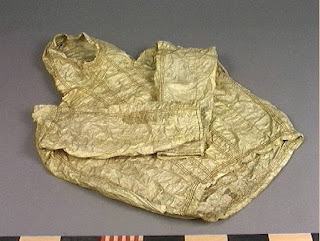
I found some 6.5 oz. waxed cotton which has a nice translucency, not unlike the anoraks made with seal intestine. Below is a prototype made with cotton twill from a pattern from the Rain Shed.